


There’s a quiet crisis in the art world, and almost no one is naming it.
Some of the most talented artists I know are also the most invisible.
If you’ve got a studio full of work you’re proud of, a following that’s slowly growing, and a few shows behind you — and still a nagging sense that the art world doesn’t quite know you exist — this letter is for you.
You’ve started hedging when people ask about your work.
Calling it “a hobby.” Downplaying it. Changing the subject.
Showing locally. Posting online. Waiting. Hoping the right person walks in.
Here’s what’s actually going on.
Your work is ready. Your presentation isn’t.
I’ve come to call it the Presentation Gap — the distance between how good your art is and how seriously the art world takes it. For most artists, that gap has nothing to do with talent.
I’d know. For 16 years I’ve run Fabrik Projects in Los Angeles, and I’ve been on the receiving end of thousands of artist submissions. I also published an art publication, called Fabrik, for 12 years in Los Angeles, and received hundreds of book submissions from artists. I can tell you exactly what makes a curator stop — and what gets set aside in three seconds.
It’s almost never the work.
It’s the packaging.
Your talent isn’t the problem. Your packaging is.
A professional art book closes that gap, because it changes the equation entirely.
Galleries take you seriously. Collectors read it as permission to invest. Curators see someone who treats their career like a professional, not a hopeful.
A book is the credential that does the talking before you ever walk in the room.
You’re not doing something unusual. You’re doing what they all did.
Here’s the part worth sitting with. The book isn’t the trophy you earn at the end of a career. For the artists who built something lasting, the book is the thing that built it.
Ed Ruscha wasn’t famous when he self-published Twentysix Gasoline Stations in 1963. He was twenty-six, a painter, and he printed 400 plain black-and-white copies and sold them for $3.50. Most didn’t sell. The Library of Congress refused to add it, on the grounds that it didn’t qualify as a book.
Today it’s considered the first modern artist book, and signed first editions have sold for as much as $60,000.
The book made the career. Not the other way around.
Alec Soth thinks in books, not shows. Sleeping by the Mississippi made his name in 2004 — as a book first, with the exhibitions coming after. He later started his own imprint, because he believes the book is the primary form, not the afterthought.
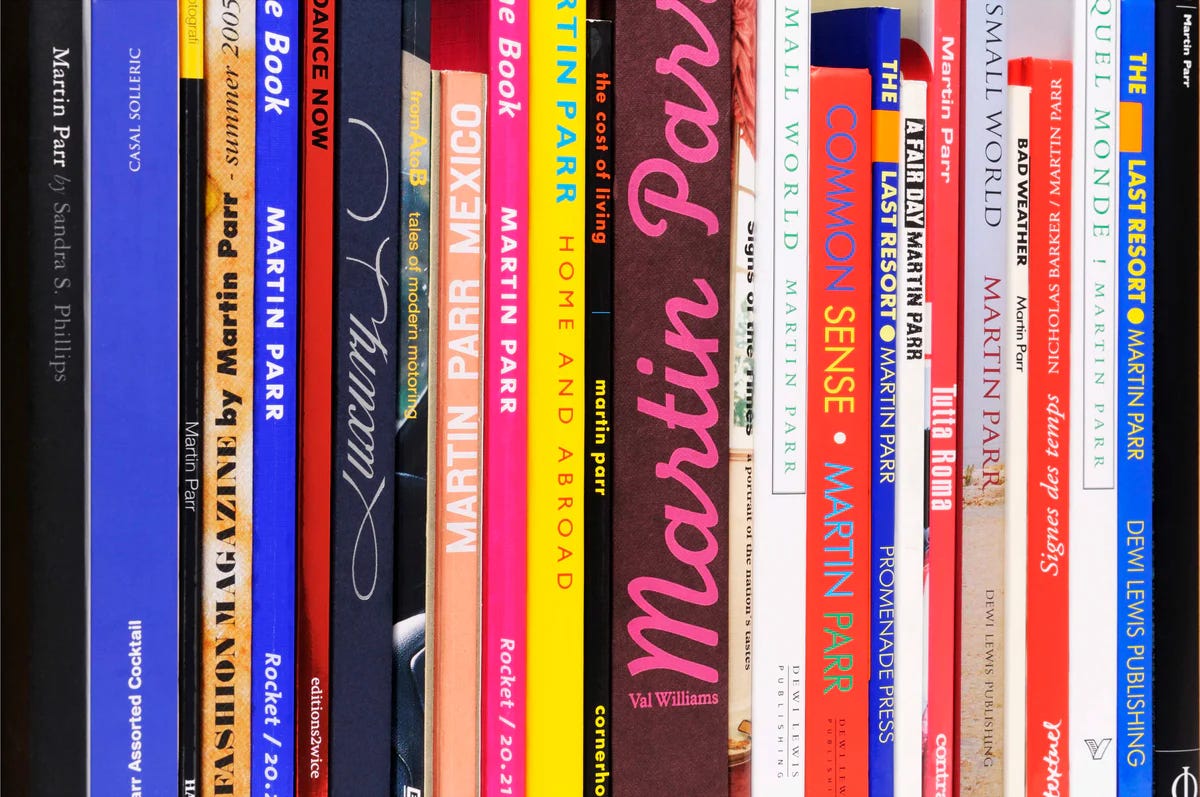
Martin Parr has made more than a hundred of them and co-wrote the definitive history of the form. Ask him what a book gives you that a wall or a screen can’t, and he points to something neither can offer: it lets you live with the work, take it in, soak it up — which is how a book creates a relationship. It’s tactile. It has a shape and a weight. A feed gives you one image at a time; a book gives you a sequence, and the sequence is the art.
Edward Burtynsky has reached more people through Oil, Water, and Anthropocene than a hundred gallery shows ever could. I exhibited opposite him at Photo London last week — and yes, his books were right there at the fair.
And this was never only a photographer’s move. Long before the photobook, painters and conceptual artists were treating the book as the work itself — Max Ernst built whole “collage novels” out of cut-up engravings in the 1930s; Dieter Roth reinvented what a book could even be in the 1960s, the same decade Ruscha did. David Hockney, a painter to his core, put sixty years of work into A Bigger Book and said of it: “I think my whole work is made for this.” Anselm Kiefer, who builds massive lead-bound book sculptures, calls the book “a symbol of learning, of transmitting knowledge.” The form belongs to any medium willing to claim it — paint, sculpture, collage, photography, anything.
The exhibition is temporary. The book is permanent.
The show comes down in six weeks. The book sits on shelves in libraries, in museums, in collectors’ homes for decades — still doing its work long after the gallery walls are repainted.
↓
The path
So here’s how you make yours. Eight weeks. We work on your actual book together — this isn’t videos you watch alone and figure out by yourself.
Weeks 1–3 — Curate your story. We look at your entire body of work and choose the 30 to 40 images that belong in the book. Then we sequence them so they tell a coherent story about who you are.
Weeks 4–6 — Design and produce. Cover, layout, typography, color, printing logistics. You approve every decision. You end with print-ready files and a printing quote.
Weeks 7–8 — Launch and leverage. We build your gallery submission kit, design your launch, and map out exactly how to use the book to open doors with curators and collectors.
By the end, you don’t have notes and good intentions. You have a book.
The part most artists get wrong
The economics aren’t what you think.
The old model — pay $3,000 to print 50 copies, then spend months trying to sell them — is backwards.
A few years ago I worked with a sculptor named Richard on his book. Not a modest one — a 10-by-13-inch, 232-page coffee table book, paired with a limited-edition leather-bound box that held the book alongside a small bronze maquette of one of his sculptures. A collector’s piece.
Here’s the part that matters. The way we marketed that limited edition, the pre-sales alone covered the full cost of printing the book and producing all fifty boxes.
The book paid for itself before it shipped.
And that wasn’t the end of it. The visibility it created — the conversations it started, the rooms it reached — led directly to a commissioned sculpture project worth $250,000.
A quarter of a million dollars. From a book.
Not because the book was a sales brochure. It wasn’t. It was a permanent record of his work that put it in front of the right people, in the right format, at the right moment. One of them said yes to something far bigger than a book.
↓
A year from now
A year from now, you’ll either have a professional book in collectors’ hands — or you’ll be exactly where you are today, competing with one hand tied behind your back.
The next cohort of The Art Book Masterclass begins June 15. Ten artists. That’s the whole room.
There are three ways in, depending on how much guidance you want, and two guarantees so there’s no risk in finding out: if the first two sessions don’t deliver real value, I refund you in full; and if you finish the eight weeks without a print-ready book, I keep working with you one-on-one until you have one.
👉🏻 View the full masterclass details
Not sure if the timing is right? Book a free 30-minute call. I’ll look at your work and give you an honest take on whether this makes sense for where you are right now. No pitch. Just a conversation.
Until next time…
— Chris
P.S. Ruscha printed 400 copies and watched most of them sit unsold. The few that moved ended up in the hands of people who knew what they were holding. If your book lands in five of the right hands, it will do more for your career than a year of chasing the right group show. David Hockney spent sixty years painting before he gathered it all into one book and realized, in his words, how much he had actually done. You don't have to wait sixty years. You can start in June. Take a look at the program →