


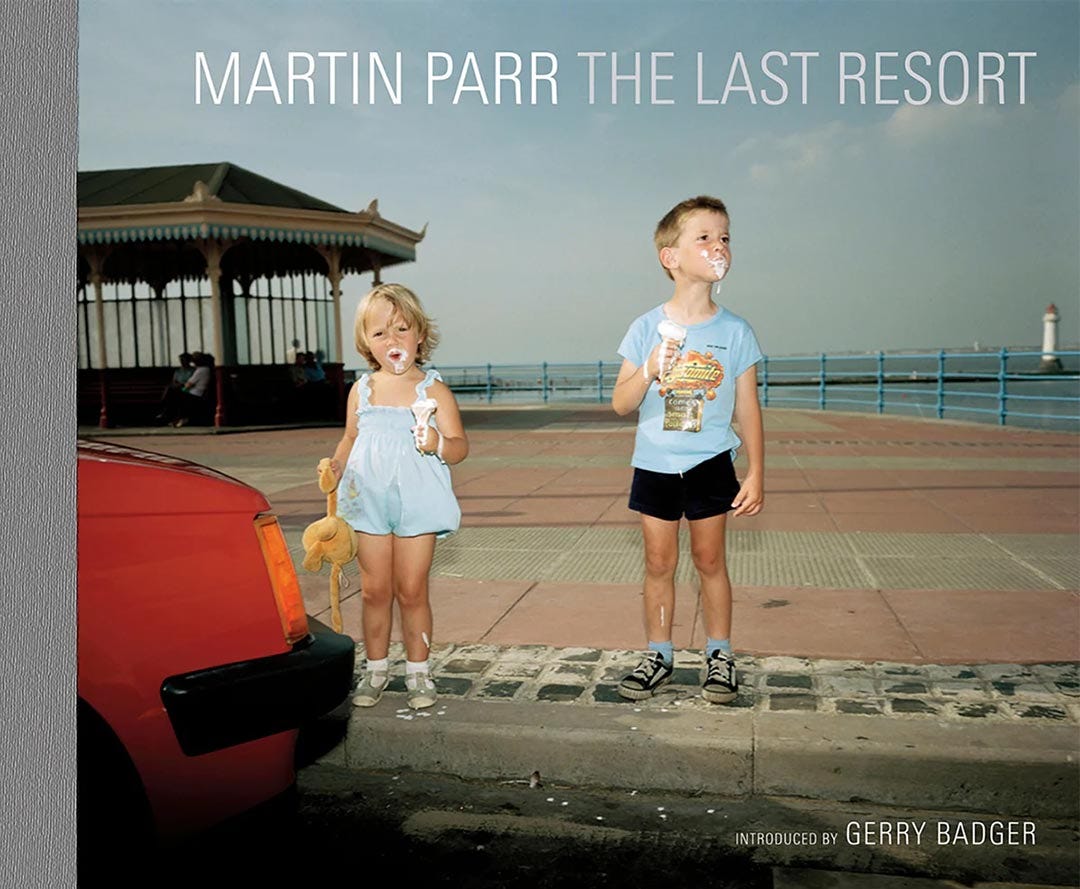
“I like making books. It’s ultimately the most satisfactory way of getting a body of work out, because it’s contained, it has a narrative, it has a beginning and an end, and it’s a physical thing. Even though we are in the day of the internet, the book still really sings out as being the ultimate statement for a photographer.”
— Martin Parr
That’s Martin Parr.
He’s made over a hundred photobooks. He co-authored The Photobook: A History — the definitive survey of the form. He has spent his entire career arguing, quietly and prolifically, that the book is the medium most photographers underestimate.
I think about that quote a lot.
↓
Parr’s argument is simple. The test of a photograph isn’t whether it can be hung on a wall. It’s whether it can hold a viewer’s attention on a page, in sequence, next to twenty or fifty or a hundred other images, with no curator and no museum lighting to do the work for it.
The book is the unforgiving test. And in his words: Don’t be lazy.
He’s not alone.
Ed Ruscha self-published Twentysix Gasoline Stations in 1963. Forty-eight pages, black-and-white photographs of gas stations along Route 66. No essay, no foreword, no commentary. He printed 400 copies and sold them for three dollars each. Most went unsold.
That book is now considered the first modern artist book. It changed what a book could be. The book wasn’t documenting the work. The book was the work.
Ruscha followed it with Various Small Fires. Every Building on the Sunset Strip. Thirtyfour Parking Lots. Real Estate Opportunities. A Few Palm Trees. Each one cheaply printed. Each one deadpan and conceptually airtight. First editions now sell for tens of thousands.
Alec Soth’s career was made by Sleeping by the Mississippi in 2004 — a book before it was a show. Niagara followed. Broken Manual. Songbook. He founded his own publishing imprint, Little Brown Mushroom, specifically because he believed the book was the primary form, not the secondary one. Soth has said in interviews that he thinks in books the way other photographers think in series.
Edward Burtynsky has spent thirty years photographing landscapes too vast to fit inside any gallery. Manufactured Landscapes. Oil. Water. Anthropocene. The book is how his work actually reaches its audience. A single Burtynsky book reaches more people than a hundred gallery shows. I know first-hand. I just exhibited opposite Edward Burtynsky at Photo London this past week. And, yes, his books were at the fair.
And it isn’t just photographers. David Hockney’s A Bigger Book. Anselm Kiefer’s massive lead-bound volumes — books that are themselves sculptures. William Kentridge’s notebooks treated as primary works. Louise Bourgeois’s published journals. Sol LeWitt’s wall drawings documented in book form. Yayoi Kusama’s monographs and autobiography. The list runs across every medium — painters, sculptors, conceptual artists, printmakers, ceramicists.
The pattern is the same for every artist who has built something lasting.
↓
The exhibition is temporary. The book is permanent.
The show comes down in six weeks. The studio visit ends in an hour. The book sits on shelves in libraries, in museums, in collectors’ homes, in the studios of artists who haven’t been born yet. Twenty years from now, the photograph you spent six weeks installing in a gallery will be a memory. The book will still be doing its work.
Parr called it the ultimate statement. Ruscha proved it was a medium of its own. Soth built a career around it. Burtynsky reached a global audience through it. Hockney scaled it. Kiefer turned it into sculpture. Kentridge made it a parallel practice to his films.
What they all understood is the same thing.
If you want your work to last beyond the run of a single show, you have to put it between covers.
↓
That’s the whole argument for the Art Book Masterclass. Eight weeks. Ten artists. Begins June 15, 2026.
If you’ve been treating the book as the thing you’d make at the end of your career, this is your invitation to reconsider.
👉🏻 View the full masterclass details
Not sure if the timing is right? Book a free 30-minute call. I’ll look at your work and give you an honest take on whether this makes sense for where you are right now. No pitch. Just a conversation.
Until next time…
— Chris
P.S. Parr’s other quote on this — the one I think about even more than the first — is just three words. Don’t be lazy. The work doesn’t make itself. It also doesn’t get any easier the longer you wait.