


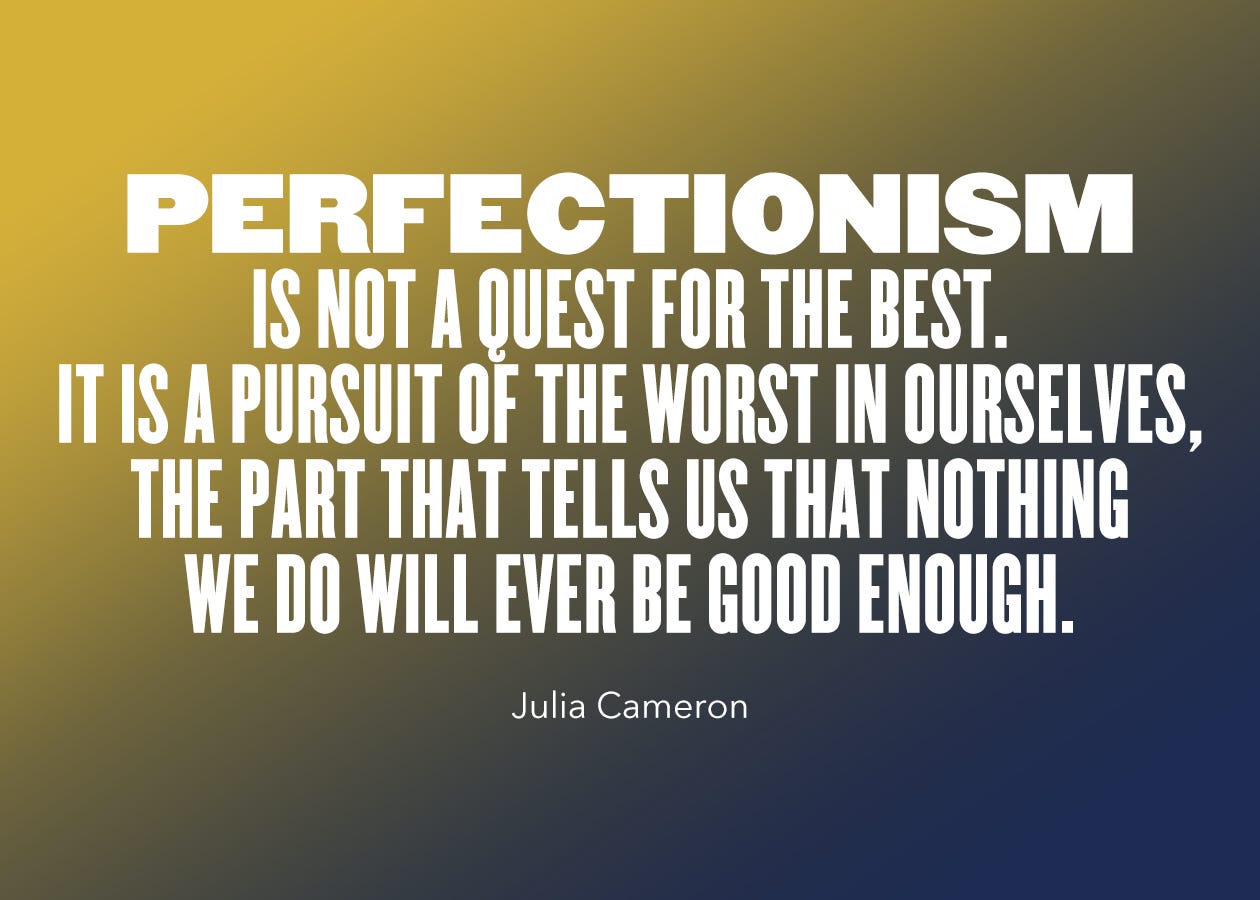
I just finished a session with an artist and felt compelled to share the experience here with you. What unfolded wasn’t just about art or creativity – it was about something deeply human that I see across all walks of life, but perhaps nowhere more clearly than in the creative process.
This particular artist has undeniable talent. Her work is compelling, emotionally resonant, and technically strong. She’s been “working on her website” for months, has incredible art but hesitates to share process shots on Instagram, and keeps promising to show me her portfolio “when it’s ready.”
Sound familiar?
During our session, we had what I’d call a breakthrough conversation. I realized she wasn’t being lazy or uncommitted – she was being held hostage by perfectionism. She wanted everything to be flawless before allowing me to help her, before sharing with the world, before taking the next step.
But here’s what we discovered together: perfectionism isn’t protecting her work – it’s suffocating it.
The Perfectionism Trap
Rick Rubin puts it beautifully:
“The imperfections you’re tempted to fix might prove to be what make the work great.”
Yet so many artists I work with treat their current state as inadequate, their work-in-progress as shameful, their authentic voice as not quite ready for prime time.
This artist had fallen into what I call the “presentation paradox” – believing that people need to see only the polished final result, not the messy, beautiful process of creation. She was curating herself out of connection.
The truth? People don’t buy art because it’s perfect. They buy it because of how it makes them feel. And they can’t feel anything if they can’t see it.
The Cost of Waiting
While she’s been perfecting her website, potential collectors are discovering other artists. While she’s been hesitating to share her process, her audience remains strangers who know nothing about her story. While she’s been protecting her work from judgment, she’s also protecting it from connection, sales, and growth.
As Jerry Saltz reminds us in How to Be an Artist:
“Your work is entirely voluntary – so procrastination is a self-harming habit.”
The Shift
Here’s what we worked on together:
Reframing the work as experiments, not monuments. Each piece she creates is valuable data that informs the next. She’s not building a perfect career – she’s building a practice.
Embracing “good enough” as a starting point, not a failure. Her website doesn’t need to be the Metropolitan Museum’s before I can help her improve it. Her Instagram doesn’t need to look like Gagosian’s before she can start building her audience.
Understanding that her story is part of her value proposition. People want to connect with the artist behind the work. Her process, her struggles, her humanity – these aren’t weaknesses to hide. They’re strengths to share.
Your Turn
If you’re reading this and feeling seen, know that you’re not alone. The drive for perfection often comes from a beautiful place – caring deeply about your work. But caring and paralyzing yourself are different things.
This week, I challenge you to share one “imperfect” thing. Maybe it’s a work-in-progress shot. Maybe it’s a story about what inspired your latest piece. Maybe it’s finally showing someone that website you’ve been “working on.”
Remember: the work wants to be seen. Your audience is waiting to connect with you. And the gap between where you are and where you want to be is bridged not by perfection, but by action.
The artist I mentioned? She agreed to show me her website next week. Not because it’s perfect, but because it’s ready for the next step. That’s the difference between being intentional and being stuck.
Your work deserves better than the perfectionism prison. Let it breathe. Let it be seen. Let it connect.
What will you share this week?
Until next time,
—Chris
P.S. Remember, I’m here to support your journey, not judge your starting point. If you’re ready to move past perfectionism and into action, I’d love to help. Sometimes we all need someone to remind us that “good enough” is actually pretty damn good.
P.S… If you’re enjoying The Intentional Artist, will you take a few seconds and forward this edition to a friend? It goes a long way in helping me grow the newsletter (and support more artists).
And if you want to be an even better friend, you can give the gift of The Intentional Artist by clicking the button below. Please let us know if you choose this option so I can send over a bonus as a thank you.
Another profound post (alliteration intended) Chris. Thank you!
Perfectionism is something I’ve worked with to try and erase - people are genuinely interested in seeing the creative process more than the finished work 🙏🌟thanks for your good advice.