


Picture your morning routine for a moment. Before your feet hit the floor, your phone is already in your hand. Notifications cascade across the screen – news alerts about political chaos, social media updates demanding your attention, emails marked urgent, text messages requiring immediate response. By the time you’ve brushed your teeth, you’ve already consumed more information than most humans processed in an entire day just a century ago.
Welcome to the age of noise.
I was with my friend Nancy the other day, an artist whose work has the kind of depth that only comes from years of careful observation and patient craft. “People don’t give themselves enough space to think anymore,” she said. “They’re always reacting, never reflecting. How can you create anything meaningful when you never pause long enough to understand what you’re actually trying to say?” It led to a deeper conversation about our society, about artists, about the challenge of creating meaningful work in a world that seems designed to prevent exactly that kind of sustained attention.
After leaving her house in a peaceful, secluded neighborhood of Los Angeles, I got in my car and started thinking about our conversation. Driving is where I do a lot of my thinking – I love it for this reason. It provides the kind of isolation and space to reflect that’s impossible when you’re in front of a computer screen (as I am now), constantly pulled toward notifications and distractions. In the car, it’s just me and the road and whatever ideas want to surface. I’ve driven across the United States several times, and some of my most important breakthroughs and ideas have come during those long stretches of highway, hours of uninterrupted thought and contemplation.
We live in a world that has declared war on silence, on reflection, on the small moments of intentional thought that once gave human beings the space to actually think about what they were doing and why they were doing it.
Every surface has a screen.
Every moment has a soundtrack.
Every silence gets filled with something louder, faster, more urgent than whatever we were just paying attention to.
And we’ve been convinced that this is progress. That staying connected to the endless stream of information and reaction makes us more informed, more productive, more successful. That if we’re not constantly consuming and responding and producing, we’re somehow falling behind in a race we can’t afford to lose.
But what if the opposite is true? What if the very noise that promises to accelerate our progress is actually the thing preventing us from making any meaningful progress at all?
The seduction of the big move
Our noise-soaked culture has trained us to believe that meaningful change comes from dramatic gestures, viral moments, and overnight transformations. We’re addicted to the idea of the breakthrough, the disruption, the quantum leap that changes everything all at once.
Social media feeds us a steady diet of overnight success stories and life-changing decisions made in an instant. The entrepreneur who built a billion-dollar company in eighteen months. The artist who went from unknown to sensation with a single post. The activist whose tweet changed the world. We feed on these stories because they promise us that if we just find the right big move, we can skip over all the small, unglamorous work that meaningful change actually requires.
Meanwhile, the steady accumulation of small, intentional actions – the kind that actually create lasting transformation – gets dismissed as insufficient, boring, or naive. Who wants to hear about someone who spent five years building something slowly when you could hear about someone who disrupted an entire industry over a weekend?
But here’s what we miss when we’re distracted by the fireworks: running one mile has more in common with running a marathon than sitting on the couch has with either. Writing one sentence has more in common with writing a book than never picking up a pen. Taking one small step toward what you want to create has more in common with actually creating it than consuming more information about why you should create it someday.
The difference isn’t in the scale of the action. It’s in the direction.
The power of intentional smallness
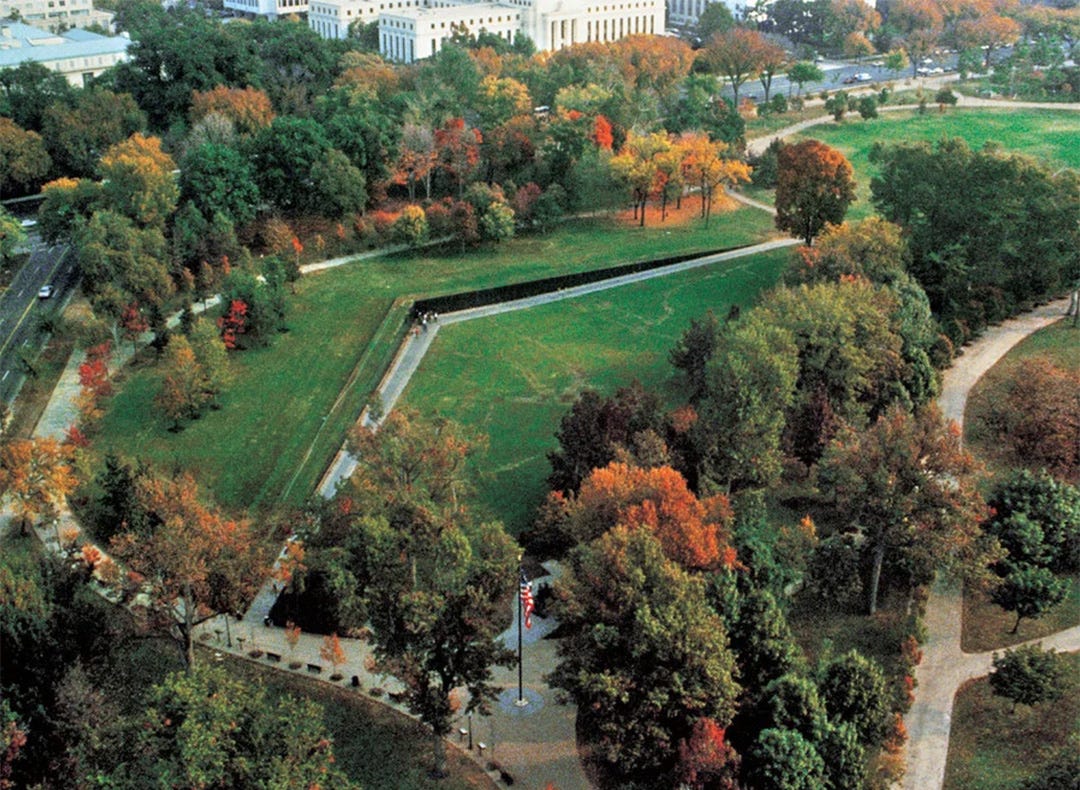
In 1981, a 21-year-old architecture student named Maya Lin was facing the biggest design challenge of her academic career. The assignment was to create a memorial for the Vietnam War that would be built on the National Mall in Washington, D.C. Around her, classmates were developing elaborate, towering structures filled with symbolic complexity – grand gestures designed to compete with the monuments already dominating the landscape.
Lin did something different. While others were adding elements, she was subtracting them. While others were building up, she was going down. While others were making noise, she was creating space for silence.
Her design was boldly simple: two black granite walls meeting at an angle, inscribed with the names of the dead and missing, emerging from and returning to the earth. No flags, no statues, no symbolic flourishes. Just names, and the space for people to encounter them quietly.
The design was so quiet, so understated, that many people initially dismissed it as insufficient. Where was the heroism? Where was the triumph? Where was the statement that matched the magnitude of what it was memorializing?
But Lin understood something that the noise of competing proposals had obscured: sometimes the most powerful response to enormity is not to try to match its scale, but to create space for individual human beings to have their own quiet encounter with meaning.
Today, the Vietnam Veterans Memorial is visited by more than five million people each year. Visitors don’t just look at it – they touch it, they leave offerings, they break down crying, they find the names of people they loved and lost. It has become one of the most powerful and moving memorials in the world precisely because it doesn’t try to tell people what to feel. It creates the conditions for them to feel whatever they need to feel.
Lin’s small, quiet design accomplished what all the grand gestures couldn’t: it created lasting transformation in the people who encounter it.
The modern epidemic of reactive living
Today, the noise has reached levels that would have been unimaginable even when Lin was quietly developing her memorial design in the early 1980s. We carry devices that deliver a constant stream of notifications designed by teams of neuroscientists to capture and monetize our attention. We live in an information environment that updates faster than human consciousness can process, where yesterday's urgent crisis is replaced by today’s even more urgent crisis, where the latest outrage crowds out any possibility of sustained thought about what actually matters.
We’ve become addicted to reaction. Something happens in the world, and we immediately need to have an opinion about it, share it, defend it, argue about it. Someone posts something, and we need to respond. An email arrives, and we need to answer it right away. A notification pops up, and we need to check it immediately.
This constant reactivity has convinced us that we’re engaged, that we’re participating, that we’re making a difference. But what we’re actually doing is training ourselves to live in a perpetual state of mental emergency, where thoughtful response becomes impossible because we’re always responding to the next thing before we’ve had time to think about the last thing.
We’ve forgotten how to pause. How to reflect. How to sit with an idea long enough to understand what we actually think about it. We’ve lost the ability to distinguish between what requires our immediate attention and what can wait. We’ve confused being busy with being productive, being connected with being engaged, being informed with being wise.
And in this environment, the idea of taking small, intentional steps toward what we want to create feels impossibly naive. Why would you spend a year building something slowly when you could potentially achieve the same result in a month with the right strategy, the right connections, the right viral moment?
I see this constantly with artists and creative professionals. They’re searching for the shortcut to success, the formula that will fast-track them to recognition and financial security. They want to know which platform to use, which style is trending, which subject matter will get them noticed quickest.
But here’s what they’re missing: the real power in artistic work – the depth that moves people, the authenticity that cuts through noise, the wisdom that resonates across generations – comes from the lived experiences you accumulate over time. The struggles, the heartbreak, the small victories, the quiet observations, the failures that teach you what you’re actually trying to say.
Some of the most powerful songs ever written came from years of wrestling with loss, love, and longing. The films that change how we see the world often emerge from directors who spent decades learning to see clearly. The books that become classics usually spring from authors who lived long enough to understand what they were actually trying to understand.
You can’t shortcut lived experience. You can’t hack emotional depth. You can’t viral your way to wisdom.
The artist who spends five years developing their voice through daily practice, paying attention to the world around them, learning from failure, and slowly building their capacity to translate internal experience into external expression – that artist is developing something that no amount of social media strategy can replicate.
But this kind of development requires exactly what our culture discourages: patience with the process, comfort with obscurity, and the faith that small daily actions compound into something meaningful over time.
The math of meaningful change
Here’s what our noise-addicted culture doesn’t want us to understand: meaningful change has never come from reaction. It comes from intentional action, sustained over time, in the service of something larger than the immediate demand for our attention.
Consider the simple math of small improvements. If you get one percent better at something every day for a year, you end up thirty-seven times better than when you started. Not thirty-seven percent better – thirty-seven times better. But if you get one percent worse every day for a year, you decline nearly to zero.
The compound effect works in both directions, and it’s purely mathematical. Small improvements compound into transformational change. Small deteriorations compound into complete breakdown. There’s no neutral – you’re always moving in one direction or the other.
But compounding requires time to work, and time requires the ability to think beyond the immediate. It requires the capacity to choose long-term trajectory over short-term satisfaction. It requires the wisdom to distinguish between what feels urgent and what is actually important.
None of these capacities can develop in the constant noise of reactive living. They require space, silence, and the increasingly rare ability to say no to the immediate in service of the eventual.
The practice of intentional steps
So what does it look like to take small, intentional steps toward meaningful change in a world designed to prevent exactly that kind of sustained attention?
It starts with the simple act of creating space for thought. Not meditation, necessarily, though that might help. Not elaborate planning systems or productivity apps. Just regular moments – daily, if possible – where you step away from the noise and ask yourself simple questions:
What am I trying to build?
What small step can I take today that moves me closer to that?
What am I doing that moves me further away from it?
These questions might sound too simple, but they require something our culture actively discourages: the willingness to be alone with your thoughts long enough to figure out what you actually think. Most of us have become so uncomfortable with silence, so addicted to external stimulation, that we’ve lost touch with our own internal compass.
But once you create even small pockets of space for reflection, once you start asking these simple questions regularly, something interesting begins to happen. You start to notice the difference between activities that move you toward what you want to create and activities that just fill time. You begin to see patterns in how you spend your attention and energy. You develop the capacity to choose response over reaction.
And then you can begin the real work: identifying the smallest possible step you can take today that shares DNA with the larger thing you want to build, and taking that step whether you feel like it or not.
Write one sentence if you want to write a book. Take one photograph if you want to build a body of work as a photographer. Have one meaningful conversation if you want to build deeper relationships. Save ten dollars if you want to build financial security. The action itself is less important than the momentum it establishes.
The quiet revolution
We live in an age that mistakes noise for signal, reaction for engagement, consumption for creation. We’ve been trained to believe that meaningful change requires dramatic gestures, that important work must be urgent work, that if we’re not constantly responding to the latest crisis or opportunity, we’re somehow failing to keep up.
But the most important work – the work that actually changes lives, builds lasting value, and creates meaning – happens in the quiet spaces between the noise. It happens when someone chooses to step away from the endless scroll and ask what they’re actually trying to build. It happens when someone decides that their long-term trajectory matters more than their immediate comfort. It happens when someone has the courage to take small, consistent steps toward something that matters, even when those steps feel insignificant compared to the dramatic gestures happening all around them.
Your phone will keep buzzing. The news will keep breaking. The social media feeds will keep updating. The world will keep demanding your immediate reaction to its latest emergency.
But in the quiet space between the notifications, in the pause before you reach for your phone, in the moment when you choose intentional action over reactive consumption, that’s where your real work is waiting.
One small step at a time. One day at a time. One quiet choice at a time.
The marathon begins with a single mile. The book begins with a single sentence. The life you want to build begins with the step you’re willing to take today.
Ready to start your own quiet revolution?
Let me know in the comments below…
Until next time,
—Chris
If you’re enjoying The Intentional Artist, will you take a few seconds and forward this edition to a friend? It goes a long way in helping me grow the newsletter (and support more artists).
And if you want to be an even better friend, you can give the gift of The Intentional Artist by clicking the button below. Please let us know if you choose this option so I can send over a bonus as a thank you.
There is a lot invested in, effectively, making us all addicts. Walking home this afternoon after spending some time sketching, I was reflecting that my always on brain is best silenced when I am outdoors, engaged in activity that can vary from the seemingly mundane (weeding / gardening) to photography or sketching. The movement of the hands, the engagement of eye, stills the mind and silences the noise. I really enjoyed reading this Chris, and was prompted to look for more on the design for the memorial. This is an interesting account showing Maya Lin’s submission sketches and statement. https://www.thoughtco.com/vietnam-veterans-memorial-winner-178136 It’s just a shame that the post and chain fence was added…