


Originality is misunderstood.
Most people talk about it like it arrives fully formed. A distinct voice. A unique style. A clean break from influence. You either have it or you don’t.
That story is flattering. It’s also false.
Originality is rarely the result of untouched genius. It’s the result of borrowed courage.
By that I mean: we become original when we finally permit ourselves to use what genuinely moves us, what genuinely obsesses us, what genuinely fits the way we see — even when it doesn’t look like the approved template for our field. Original work begins with permission, not invention.
This is true in almost every serious discipline.
In science, the breakthrough is often a method imported from somewhere else. A biologist borrows from statistics. A physicist borrows from philosophy. A computer scientist borrows from neuroscience. The novelty isn’t the discovery. It’s the willingness to notice that a tool from one room belongs in another.
Athletes do the same thing. The best ones don’t just repeat fundamentals. They study adjacent techniques, rethink recovery, adapt training for their body rather than the average body. At the highest level, improvement is personal before it’s public. It looks like deviation before it looks like mastery.
Craft works this way too. Chefs borrow from architecture. Musicians from filmmakers. Designers from choreographers. Writers from comedians. The interesting ones aren’t trying to be random. They’re trying to become more exact. They’re looking for the form that can carry their taste.
We are no different. But many of us get trapped in a more anxious myth.
The myth says that to be original, you have to avoid influence. So we get cautious. We hide our references. We flatten our interests. We try to sound like the kind of person who does this work.
That is how we become derivative while trying not to be.
Real originality is metabolized, not invented. You take in a lot. You live with it. You test it against your own standards. Over time, your taste starts making decisions faster than your insecurity can interrupt them.
That process is messier than the myth allows. It usually starts with visible borrowing.
A young writer imitates sentence rhythm. A photographer copies framing. A strategist borrows the sharpness of someone else’s argument. This isn’t failure. It’s apprenticeship.
The problem isn’t borrowing. The problem is stopping there.
At some point, the work has to pass through your actual life.
What have you noticed that others gloss over? What tensions do you keep returning to? What kinds of beauty do you trust? What forms feel honest, even if they’re less rewarded? What are you trying to protect in the work?
Those questions matter more than “How do I stand out?”
Standing out is a side effect. Recognition is downstream. Originality is what happens when your influences stop being costumes and start becoming building materials.
This is also why cross-domain learning matters.
If you only study your own field, you inherit its default anxieties along with its techniques. You learn what’s fashionable, what’s legible, what gets praised. That can make you competent. It can also make you timid.
Other fields reveal alternative standards.
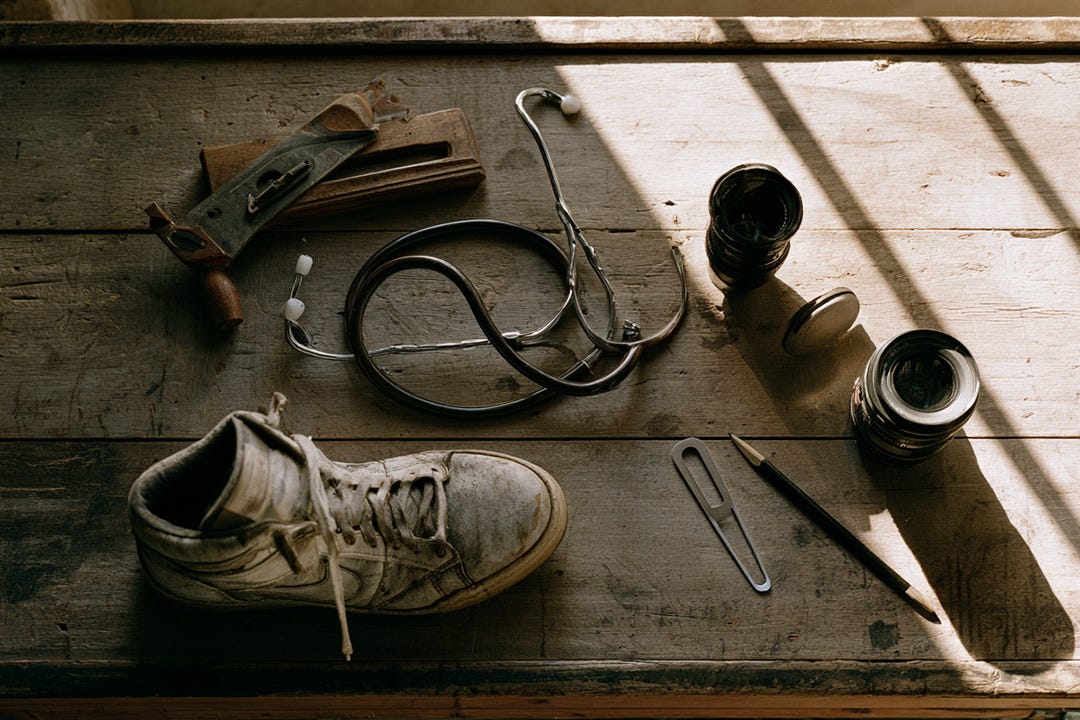
Carpentry teaches respect for joints — the invisible structural decisions that hold a piece together. Medicine teaches triage — not every problem deserves the same level of intervention. Distance running teaches that consistency beats emotional intensity. Jazz teaches that discipline and improvisation are not opposites; one makes the other possible. Ecology teaches that healthy systems are diverse, adaptive, resistant to monoculture.
These lessons are practical, not decorative.
A writer who learns from runners stops waiting for inspiration and builds a repeatable pace. A designer who learns from ecology stops over-optimizing for one platform, one audience, one trend. An artist who learns from carpentry pays more attention to composition, sequence, load-bearing decisions — instead of surface flair. A founder who learns from jazz stops over-scripting every move and becomes more responsive inside a strong structure.
This is also why sustainable visibility is hard for those who chase only format and tactics. If your whole model is built on keeping up, your work becomes externally paced. You become highly responsive and internally hollow. You may stay visible for a while. You become less and less recognizable to yourself.
Sustainability requires a different approach.
It requires building from durable questions instead of temporary incentives.
What do I return to even when no one asks for it? What kind of contribution am I actually trying to make? What cadence keeps me sharp without making me resent the work? What material is rich enough that I can revisit it across seasons?
These aren’t branding questions. They’re practice questions. And practice is where identity becomes real.
Many of us secretly hope identity will arrive before practice. First certainty, then output. But identity forms the other way around. Through repetition, refusal, revision, and accumulation, you become easier to recognize — to yourself first, then to others.
That’s why self-trust matters more than self-expression.
Self-expression is often treated as the goal. But expression without trust quickly becomes performance. You start explaining yourself instead of building. You start signaling taste instead of exercising it. You start choosing what looks like you over what is actually true.
Self-trust is quieter. It lets you keep a strange idea long enough to test it. It lets you discard competent work that’s misaligned. It lets you borrow boldly without feeling contaminated by influence. It lets you make fewer, better decisions.
And self-trust can be trained. Not by affirmations. By evidence.
You keep promises to yourself. You finish things. You develop criteria. You revise with precision instead of self-contempt. You learn the difference between discomfort that means growth and discomfort that means drift.
Over time, this builds a sturdier creative identity than any public positioning exercise can.
The contrarian truth: originality is less about being different and more about being integrated.
Integrated people make more distinctive work because they’re less divided. They aren’t constantly cutting themselves apart to fit the expectations of a niche, a market, or a scene. They have enough range to pull from multiple domains and enough discipline to make those influences cohere.
That coherence is what people experience as voice.
Not novelty for its own sake. Not eccentricity. Not chaos. Voice is what happens when judgment becomes stable. When your choices begin belonging to each other. When someone can feel that the work could only have been made by a person who sees in that particular way.
This takes longer than people want.
It’s slower than trend participation. Slower than mimicry. Slower than optimizing for immediate recognition.
But it ages better.
You stop trying to be seen and start trying to become legible through repeated honest work.
So if you’re worried that you’re too influenced, too late, too undefined, too cross-disciplinary to count — good. That probably means you’re close to making something real.
Let yourself borrow. Let yourself study. Let yourself admire. But don’t stop at admiration. Carry what you love into contact with your own standards, obsessions, constraints, and questions. Make it answer to your life.
That’s where originality starts.
Not in purity.
In permission.
This is the kind of thinking we work through inside The Creative Practice — a platform of tools, systems, and a working community for artists, filmmakers, musicians, photographers, designers, and the rest of us trying to get the work seen. Not more education. Better instruments. The doors open soon. If that sounds like the room you’ve been looking for, the waitlist is here.
Until next time…
— Chris