


I’ve run a gallery in Los Angeles for fifteen years. In that time I’ve received thousands of artist emails — hundreds every year, still coming in this week.
Most of them are good artists. A lot of them are making strong work. But most of the emails get closed in under ten seconds — not because the art isn’t good enough, but because the email itself doesn’t give me a reason to keep reading.
I want to show you what I mean. Below are screenshots of real artist submissions pulled directly from my gallery inbox. I’ve redacted the artists’ names, email addresses, gallery references, and details about their work to protect their privacy — but nothing else has been changed. These are real emails from real artists. Then I’ll show you the one I actually replied to, and why.
Email A:
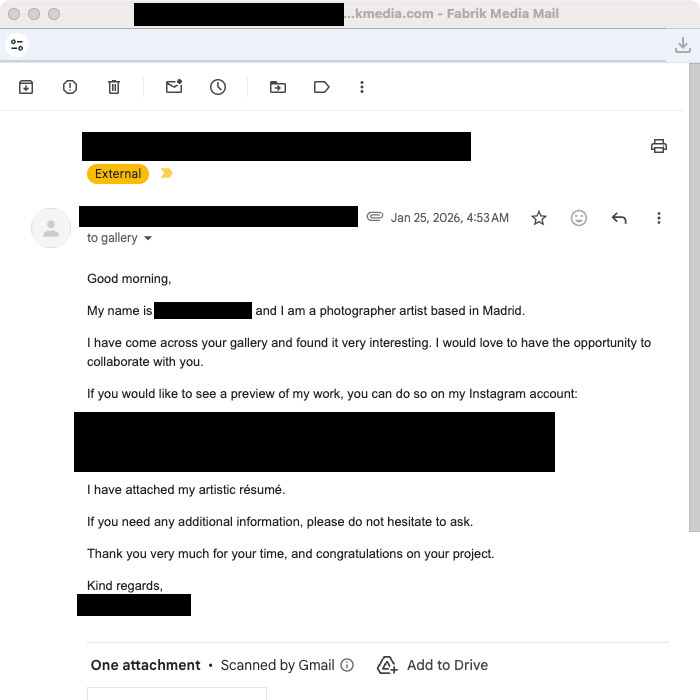
Good morning,
My name is [Artist], and I am a photographer based in Madrid.
I have come across your gallery and found it very interesting. I would love to have the opportunity to collaborate with you.
If you would like to see a preview of my work, you can do so on my Instagram account: @[handle]
Three sentences, and not one of them tells me anything about the fit. “I found your gallery very interesting” — which part? The program? A recent show? The roster? And pointing me to Instagram instead of a curated portfolio means I’m now doing the artist’s homework for them. I closed this in about four seconds.
Email B:
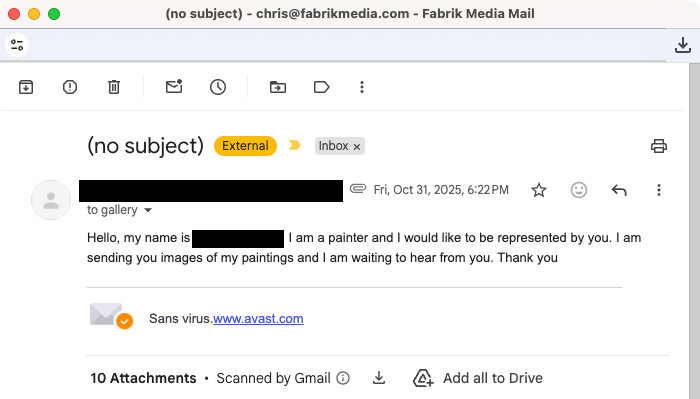
Hello, my name is [Artist]. I am a painter and I would like to be represented by you. I am sending you images of my paintings and I am waiting to hear from you. Thank you.
No subject line. Two sentences. Ten unsolicited image attachments. “I am waiting to hear from you” after giving me nothing to respond to. This is the email equivalent of dropping a stack of canvases on someone’s desk and walking out.
Email C:
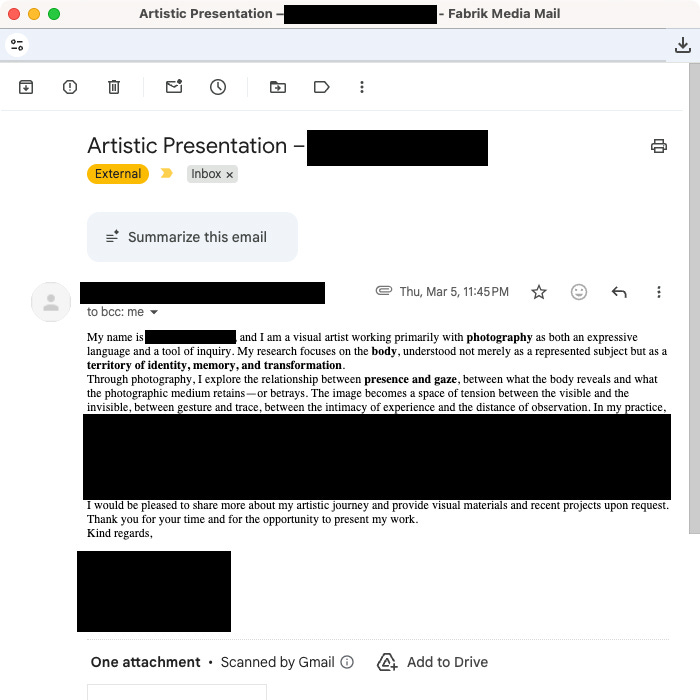
My name is [Artist], and I am a visual artist working primarily with photography. My research focuses on the body, understood not merely as a represented subject but as a territory of identity, memory, and transformation. Through photography, I explore the relationship between presence and gaze, between what the body reveals and what the photographic medium retains — or betrays...
This went on for three more paragraphs. It reads like a graduate thesis abstract, not an email to a human being. Beautiful writing, probably — but I’m a gallerist with forty unread messages, not a panel reviewer. There was no mention of my gallery anywhere in it. Not once. So this artist clearly doesn’t know anythign about the gallery.
Now compare those with Email D:
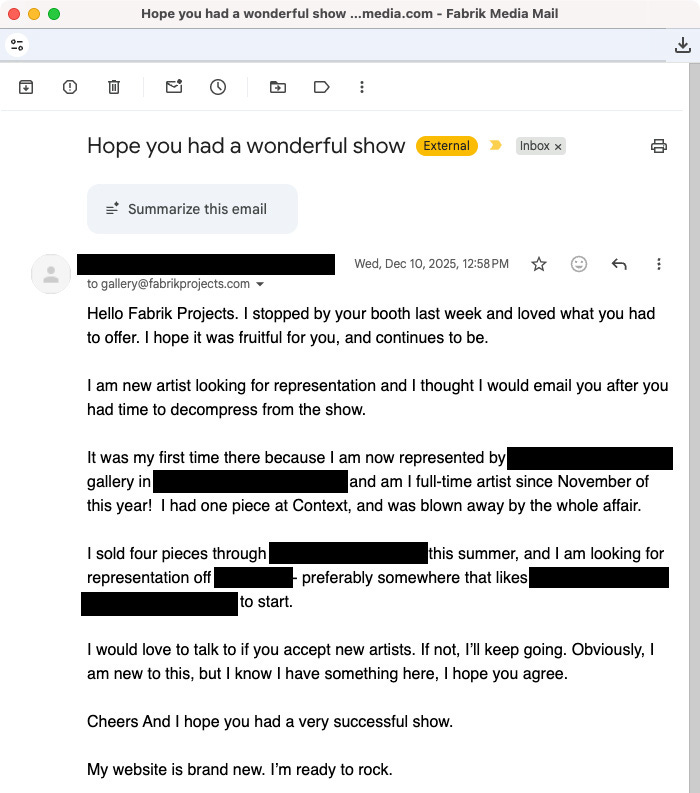
Hello Fabrik Projects. I stopped by your booth last week and loved what you had to offer. I hope it was a great show for you.
I’m a new artist looking for representation and I thought I’d email you after you had time to decompress. I’m currently represented by [Gallery] in [City] and have been a full-time artist since last year. I sold four pieces through them this summer and am looking to expand.
I would love to talk to see if you accept new artists. If not, I’ll keep going.
That’s it. That’s the one I replied to.
Why? Because this artist did four things none of the others did: referenced a specific interaction (the booth visit), showed awareness of my time (waited until after the fair), gave me real context about where they are in their career (represented, selling, expanding), and closed with confidence instead of desperation. “If not, I’ll keep going” is the best close I’ve seen in an artist email in a long time.
The one thing that would have made this even better? Finding my name.
“Hello Fabrik Projects” is already miles ahead of “Dear Gallery” — but “Hi Chris” would have made it feel like a conversation instead of a pitch. That takes about thirty seconds on most gallery websites. It’s a small thing, but small things are the whole game here.
These are the pattern I’ve watched play out for fifteen years running Fabrik Projects in Los Angeles. Hundreds of submissions a year, and the gap between the artists who get replies and the ones who don’t almost always comes down to three things happening in the first few sentences:
Specificity over formality. The artists who get replies reference a recent show, name an artist on the roster, or mention a piece of writing from the gallery’s own site. It signals that this isn’t a mass email, and gallerists can smell a mass email from the subject line.
A point of connection, not a list of credentials. Your MFA, your residency, your exhibition history — those matter, but they belong further down the email or in your CV attachment. The opening needs to answer one question: why this gallery? If your first sentence could be copy-pasted to fifty other galleries without changing a word, it’s not doing its job.
Permission, not pressure. “I’d love to share a few images if you’re open to it” is a completely different energy than “I am sending you images of my paintings and I am waiting to hear from you.” One respects my time. The other assigns me homework.
That’s the whole game. Not talent. Not connections. Not luck. Just the craft of writing an email that signals — in the first three seconds — that you understand the person reading it.
Most artists never learn this because nobody teaches it. Art school covers critique, theory, history, technique — but not the ten-minute writing task that determines whether your work ever gets seen outside your studio.
I’ve watched too many good artists sit on strong work for years because they couldn’t get past the blank email draft. They’d open a compose window, stare at it, write three sentences, delete them, and convince themselves the work wasn’t ready yet.
The work was ready. The email wasn’t.
That frustration is why I created the Gallery Pitch Toolkit.
I went back through years of my own inbox — the emails I replied to, the ones I forwarded to curators I trust, and the ones I deleted in seconds — and I pulled out the patterns. What the good ones had in common. What the bad ones kept getting wrong. And I turned it into a system any artist can use.
Ten cold-email templates covering every scenario you’ll actually face — first intro, warm referral, post-show, art fair follow-up, international outreach, re-engagement after silence. Each one paired with a fully worked example so you can see exactly how the personalization works in practice.
Plus a 25-line subject line swipe file, a 3-email follow-up sequence (Day 5, Day 14, Day 30), a 10-point research checklist to do before you ever hit send, and a rejection response template that turns a “no” into a “not yet.”
It’s $17. The price of three cups of coffee. And it comes with a 14-day refund if you don’t find it useful.

I’m not going to tell you this guarantees a gallery show. Nothing does, and anyone promising that is lying. But if you put in the work — personalize each template, do the fifteen minutes of research, send the follow-ups — you’ll be writing better emails than 95% of the artists in any gallerist’s inbox.
The art gets you the show. The email gets you the meeting.
Start with the email.
Until next time…
— Chris